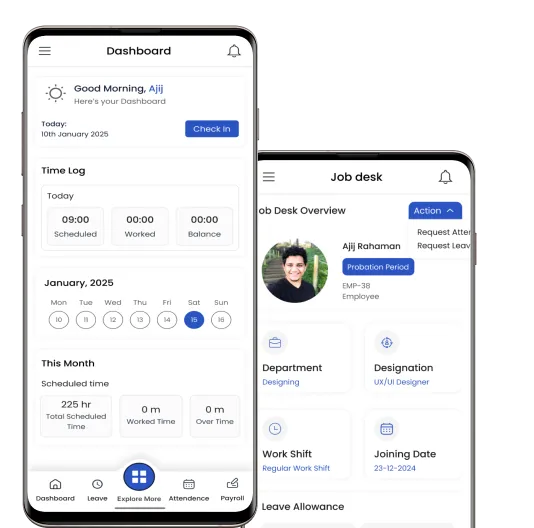
For decades, tracking attendance was a basic administrative task — employees clocked in, HR kept records, and payroll processed the hours.
But today’s workplace isn’t the same.
- Teams are hybrid and remote
- Compliance is stricter
- Fraud like buddy punching is more common
Traditional attendance systems are falling behind.
That’s why AI attendance management systems — especially those integrated with AI face recognition devices, AI employee monitoring software, and AI productivity trackers — are quickly becoming the new standard.
1. What Counts as a “Traditional” Attendance System?
Traditional systems include:
- Manual Sign-in Sheets → Prone to errors and falsification
- Swipe Cards & PIN Codes → Can be shared
- Fingerprint Scanners → Require contact and can be spoofed
These methods record time but don’t provide insights into productivity or compliance.
2. What Makes AI Attendance Different?
AI attendance systems:
- Use biometrics (face recognition) for secure check-ins
- Integrate with cloud-based dashboards for real-time access
- Offer predictive analytics to detect absenteeism trends
- Sync with payroll and HR systems automatically
3. Head-to-Head Comparison
| Feature | Traditional Systems | AI Attendance Systems |
| Accuracy | ❌ Low–Medium | ✅ High |
| Fraud Prevention | ❌ Weak | ✅ Strong (Biometric) |
| Remote Check-ins | ❌ No | ✅ Yes |
| Real-Time Analytics | ❌ No | ✅ Yes |
| Integration with Productivity | ❌ No | ✅ Yes |
| Compliance Automation | ❌ No | ✅ Yes |
4. How AI Solves the Biggest Attendance Problems
a. Buddy Punching
With AI face recognition attendance machines, proxy check-ins are impossible.
b. Manual Errors
Automated logging means no wrong timestamps or missing entries.
c. Remote Worker Tracking
Geo-fencing allows accurate attendance logging from authorized locations.
d. Payroll Delays
Attendance data flows directly into payroll for instant processing.
5. Benefits of Switching to AI Attendance
- Higher productivity from transparent tracking
- Improved compliance with labor laws
- Better workforce insights for HR decision-making
- Cost savings from fraud prevention and automation
6. Integration with Other AI Workforce Tools
AI attendance works best when connected to:
- AI Employee Monitoring Software → Matches hours to activity levels
- AI Productivity Tracker → Links attendance with output quality
- AI Employee Tracking App → Extends monitoring to mobile teams
7. Industry Adoption Trends in 2025
- IT & Tech → Hybrid teams need secure remote check-ins
- Manufacturing → Shift-based tracking across multiple sites
- Healthcare → Continuous staff monitoring for compliance
- Retail & Hospitality → Centralized multi-location tracking
8. Overcoming Concerns About AI Attendance
Some businesses worry about:
- Cost → But cloud-based AI attendance is affordable at scale
- Privacy → Solved with encrypted biometric storage and consent policies
- Implementation time → Most systems integrate within days, not weeks
9. The Future of Attendance Tracking
- Emotion AI → Recognize stress patterns in employee attendance
- IoT Integration → Smart doors and sensors for passive check-ins
- AI-Driven Scheduling → Auto-assign shifts based on attendance history
Conclusion: Why Smart Businesses Are Switching Now
Traditional attendance methods can record time, but they can’t ensure accuracy, prevent fraud, or provide insights.
In contrast, an AI attendance system:
- Delivers real-time, fraud-proof attendance data
- Integrates with AI face recognition machines
- Connects to AI productivity trackers and AI monitoring software
- Boosts both efficiency and security
In 2025, the smartest companies aren’t waiting — they’re switching to AI-powered attendance now.